


By Ovat Abeng
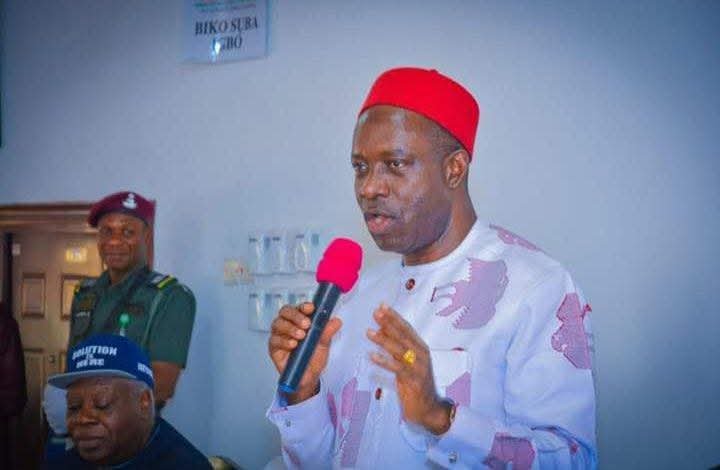
The Governor of Anambra State, Chukwuma Charles Soludo has called on Nigerian academics to transition from passive teaching to active developmental intellectualism, stressing that the wealth of knowledge within university walls must directly translate into public policy and societal transformation.
Delivering a lecture on Tuesday, at the University of Nigeria, Nsukka, during the 6th Biennial Adada Lecture Series organised by the Association of Nsukka Professors (ANP), the Governor argued that while the nation produces thousands of scholarly articles, the disconnect between academic research and national governance remains a significant barrier to progress.
The Governor observed that history has always been shaped by a fusion of thought and action, citing pioneers like Isaac Newton, Nnamdi Azikiwe, and Kwame Nkrumah as examples of thinkers who built the foundations of modern society, noting that while Nigeria currently boasts more academics than in previous decades, academic discourse has ironically never had less authority in national life.
READ ALSO: Suki Support Groups Set to Adopt Tinubu, Otu, Ekpenyong Ahead of 2027
He described this phenomenon as a period of more noise but less light, where the link between intellectual change and government policy has been severed, emphasizing that nations are not developed by natural resources alone but by the ideas that precede the building of institutions.
The Governor challenged the gathered scholars to reflect on the local impact of their expertise, questioning why the Adada zone is not yet a “first-world” environment despite being home to hundreds of professors.
While asserting that intellectualism without activism is sterile and that the hunger for deep knowledge in contemporary society has hit an alarming low, the Governor stated that the intellectual must become a multi-tasker who combines rigorous research with a sense of personal responsibility.
He advocated for “sacrificial volunteerism,” urging professors to take initiative in solving collective problems regardless of institutional constraints, revealing that in Anambra State over the last four years, his administration has focused on laying the foundation for sustainable development by bringing this brand of intellectual responsibility into the heart of governance.
Turning his attention to regional challenges, the Governor touched on sensitive issues including state creation, marginalization, and the Biafra agitation, and pointed out the historical significance of the Nsukka auditorium in the first Biafra war, suggesting that the lack of extensive academic research on such pivotal events from within the institution is a missed opportunity for intellectual leadership.
Governor Soludo stated his firm belief that the interests of the Igbo people are best served within a united, functional Nigeria, maintaining that intellectuals must be the ones to lead this conversation, crafting the sustainable solutions required to move the region and the nation forward.
The lecture concluded with a stern warning against “standing akimbo” or remaining indifferent to the country’s trajectory, as the Governor reminded the audience that talent is insufficient without active participation and that the cost of intellectual silence is too expensive for the continent to bear, and challenged the Association of Nsukka Professors to ensure their work moves from the pages of journals into the halls of policy-making to drive the African renaissance.
Earlier, the Vice Chancellor of the University of Nigeria, Nsukka, Professor Simon Ortuanya, described the Governor’s visit as a homecoming, reiterating the Governor’s great work for the country and, indeed, humanity.