








By Kelvin Obambon
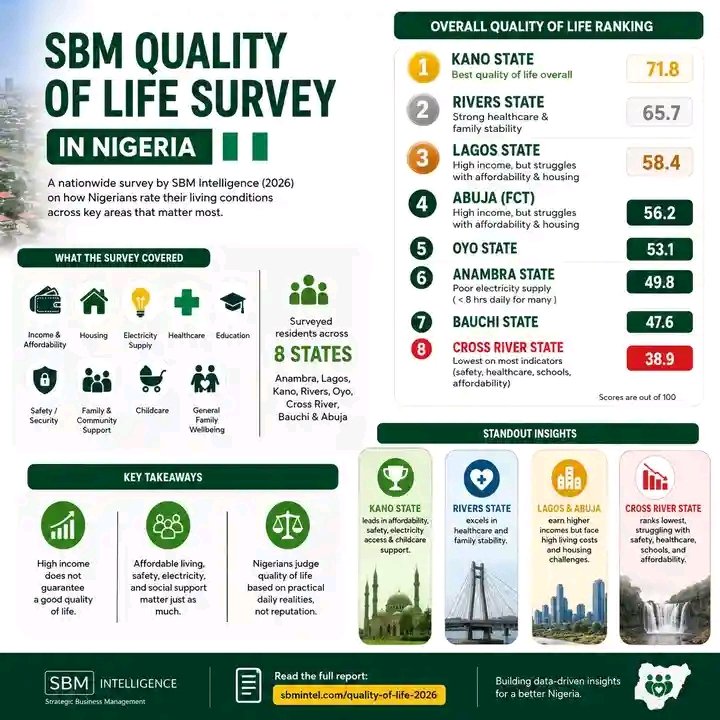
The Cross River State Consultative Forum (CRSCF) has raised serious reservations over a recently published quality-of-life report by research firm SBM Intelligence, which ranked Cross River State poorly across several governance and livability metrics.
In a statement issued in Calabar on May 28, 2026, and signed by its Chairman, Barr. Eyo Nsa Ekpo, and Secretary, Dr. Julius Ochim Okputu, the Forum strongly disputed the report’s conclusions, labeling them as “analytical overreach” driven by severe methodological limitations.
While acknowledging the role of independent policy research in a democracy, the CRSCF argued that the publication, titled “Where Nigerian Families Actually Thrive,” relied on an incredibly small sample size to draw sweeping conclusions about millions of residents.
According to the Forum, SBM Intelligence based its sweeping findings on a Quality of Life Survey of just 442 respondents and a Power Survey of only 191 respondents across multiple states and the Federal Capital Territory.
READ ALSO: ANSAA pegs N50m permit fee for Tinubu, Obi, Atiku, others campaign billboards in Anambra
The CRSCF maintained that these figures are statistically inadequate to capture the diverse socioeconomic realities of Cross River State. The group expressed concern over the report’s use of sensational terms like “state collapse” and “systemic governance failure,” which they claim blur the line between empirical analysis and emotional editorial commentary.
“Reducing the state’s realities to sweeping narratives of ‘collapse’ neither advances constructive policy engagement nor reflects the resilience, enterprise, and aspirations of its people,” the statement read.
The Forum also pointed out stark internal contradictions within SBM’s own data. While the report painted a picture of institutional failure, it simultaneously revealed that 59.1% of Cross River respondents expressed optimism about future power supply improvements – a confidence rate higher than those recorded for Abuja and Anambra.
In Rivers State, which performed strongly in health and infrastructure metrics within the same report, 40.4% of respondents still expressed a desire to relocate, suggesting that migration intentions are driven by broader psychological and national economic factors rather than local governance alone.
The Forum further criticized SBM Intelligence for failing to account for the national macroeconomic headwinds affecting all 36 states – such as post-subsidy adjustments, inflation, and exchange rate instability – while ignoring the tangible interventions of Governor Bassey Edet Otu’s administration between 2023 and 2026.
Under Governor Otu’s “People First” policy framework, the Forum highlighted several ongoing milestones aimed at restoring the state’s infrastructure and economic vitality, including extensive road construction and rehabilitation projects are active across the Calabar – Akamkpa corridor, the Okuku – Yala axis, and rural networks in Yakurr, Biase, Ikom, and Odukpani, alongside drainage overhauls in Calabar.
“Primary healthcare centers across all 18 Local Government Areas (LGAs) have been revitalized, dialysis centers in Calabar and Ogoja upgraded, and health insurance coverage expanded for vulnerable populations.
“The administration has consistently paid WAEC fees for thousands of students over the last three years, rehabilitated classrooms, and cleared a decade-long backlog of pensions and gratuities while employing over 10,000 citizens into the state civil service.
“Attendance has tripled at Carnival Calabar following deliberate repositioning, alongside restoration efforts at the Marina Resort and Obudu Ranch Resort. Additionally, youth-focused agricultural empowerment schemes are underway via partnerships with LIFE-ND, APPEALS, and FADAMA.”
Citing data from the National Bureau of Statistics (NBS), the Forum asserted that the socioeconomic challenges facing Cross River are nationwide issues and do not justify characterizations that could damage investor confidence, hurt tourism, and undermine public morale.
The CRSCF closed its statement by calling on SBM Intelligence and other research organizations to adopt more transparent methodologies, broader sampling frameworks, and balanced analytical language in the future, reaffirming its own commitment to evidence-based advocacy and constructive policy dialogue.