





By Kelvin Obambon
For twenty-four years, the massive trucks rolling out of the limestone-rich earth of Akamkpa and Akpabuyo Local Government Areas have carried away untold wealth in cement, leaving behind a single-lane road choked with dust, polluted water, cracked houses, and shattered livelihoods.
With a critical 2027 mining license renewal on the horizon, host communities are demanding an end to what they describe as “generational exploitation.”
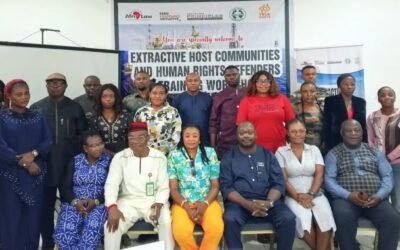
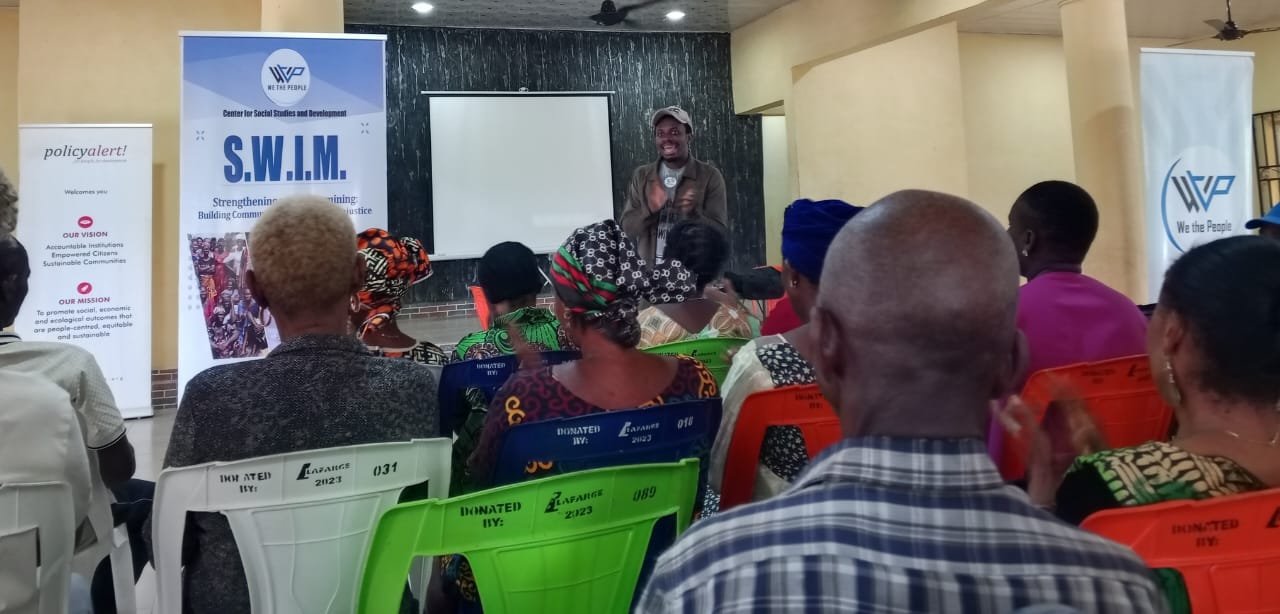
At a tense community dialogue held at the Mbobui community town hall, civil society groups, resource experts, and local stakeholders gathered to confront a grim reality: despite sitting on some of the largest limestone deposits in Nigeria, host communities like Mbobui, Akansoko, Abiati, Mfamosing, and Akwa Ikot Effanga have been relegated to passive onlookers while foreign companies and local gatekeepers enrich themselves.
‘It is Given as a Privilege, Not a Right’
Ken Henshaw, the Executive Director of We The People (WTP), did not mince words when addressing the crowded town hall on Tuesday 9 June, 2026. He noted that preliminary research conducted by his organization in 2021 exposed a systemic pattern of community abuses, economic deprivation, and health hazards that everyone has ignored.
“Communities are just there as very passive participants in this process, contributing absolutely nothing, having absolutely no say in it,” Henshaw said. “The mining company basically decides what communities should get from their mining activities. And it is given to communities not as rights, but as some kind of privilege, a fringe benefit from the back of their pocket as a goodwill gesture. And we thought that is wrong. That’s absolutely wrong.”
He revealed that the transition of operations from United Cement Company of Nigeria (Unicem) to Lafarge, and its subsequent divestment to a Chinese firm, has only perpetuated a cycle where community agency remains “exceptionally weak.”
Worse still, Henshaw alleged that the extraction is not just shortchanging the villagers, but the state itself. Based on data analyzed by WTP, the Cross River State Government is being fleeced by up to 300% of what it deserves due to inaccurate calculations of royalties and land rents.
“We know how much cement is going out of here. This is a single lane road. There are no rivers to ship anything else,” Henshaw told the community, urging them to actively monitor the operations. “If communities stand out there and count the number of trucks leaving this place, they can very easily on their own calculate what royalty the state government is owed.”
24 Years of Broken Agreements
The structural failure of corporate social responsibility in the host communities was further dissected by Mfon Gabriel, a resource person from Policy Alert and consultant on the Strengthening Women In Mining (SWIM) Project. Gabriel revealed that since 2002, a legally binding Community Development Agreement (CDA) has been virtually non-existent or ignored.
“We already have an arrears of CDAs that have not been respected by Lafarge,” Gabriel stated. “We feel that the six communities hosting this asset have been robbed, exploited, and shortchanged these past 24 years of operations.”
Gabriel drew a sharp contrast between corporate public relations and the grim ecological reality on the ground, asserting that “Lafarge announced to the world in its sustainability report that they are doing everything possible to reduce their carbon footprint. But the stark reality on ground shows the reverse. Water is polluted, dust is everywhere, houses are not remediated… What we are seeing here is just like how Europe underdeveloped Africa. The road here is just where minerals will be extracted and then exported. But the real people where these resources have been extracted are not impacted.”
Gabriel is therefore calling for an immediate environmental audit by the Federal Ministry of Environment to match Lafarge’s real-world impact against its official Environmental Impact Assessment (EIA). Furthermore, he urged the Cross River State Government to prioritize the constitutional 13% derivation fund explicitly for the development of these host communities.
The town hall meeting stemmed out of the Strengthening Women In Mining (SWIM) project led by the project officer of mining and forestry at We The People, Nsikak Udofot. Nsikak highlighted several successes of the SWIM project, one of which included a 2-day “Know the law” training meant to equip communities with legal empowerment strategies to address mining injustices and a legal handbook to guide communities in advocacy.
The Enemy Within: Local Saboteurs and Spiritual Warfare
While blame was squarely leveled at corporate giants, the dialogue took a raw, introspective turn as stakeholders admitted that the communities are also being fractured from within by corrupt elites, self-serving youth factions, and compromised contractors.
Raphael Effiong, a stakeholder from the Abiati primary landlord community, defended the multinational to an extent, arguing that local contractors often betray their own blood.
“Lafarge happens to give 25 slots or 30 slots for your community, and you decide to bring people from Delta, from Jos, from Kogi to come and do the work. That you don’t blame Lafarge,” Effiong argued, adding that local elites routinely use substandard materials on community projects. “If we have conscience, we should be able to do the right thing, especially when it involves us.”
The lengths to which these internal “power brokers” will go to protect their interests became shockingly clear when Reverend Rita Archibong, the woman leader of Akwa Ikot Efanga, spoke.
She narrated how an effort in 2025 to unite the six host communities into a formidable bargaining bloc ahead of the Chinese takeover was violently derailed by a youth group known as “AA,” which allegedly controls the lucrative trade of factory scraps.
“They are trying to stop us, other community members, so that we will not benefit,” Reverend Archibong said. “Up till today, those people who organized the meeting were attacked spiritually. Like one of my uncles, he almost lost his life because of that meeting that we had.”
Looking to 2027: The ‘Wetin We Gain’ Campaign
The community dialogue, which exhaustively dissect and assimilate a Policy Alert’s document titled, “Wetin We Gain” (What Do We Gain?), marks the beginning of a coordinated push to re-arm local populations with the tools of data tracking, contract transparency, and legal recourse using the Freedom of Information (FOI) Act. We The People, on its part, is actively working on a legal handbook to guide mining host communities in advocacy, and thus armed them with knowledge on how to seek justice for the exploitation of their natural resources.
With Lafarge’s mining license set to expire in 2027, We The People, Policy Alert, Onyx Foundation and local community leaders see an immediate, high-stakes window for remediation. The consensus from the Mbobui town hall was clear: the era of accepting “peanuts” given as charity is over. Moving forward, the communities intend to leverage their ancestral rights to ensure they are no longer left in the dust of their own wealth.