



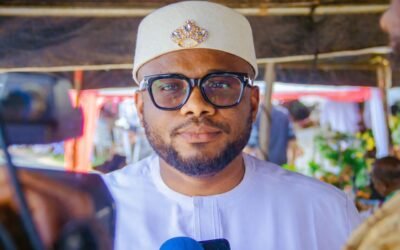



In Cross River State’s sporting world, table tennis is not just seen as a sport played in school halls and community centres. It has become a structure of influence, development, as one of the few sports tha brings laurels and glory to the state. Having produced renowned stars keep representing the state and nation at both national and international platforms. At the centre of this structure is Rt. Hon. Orok Otu Duke, a figure whose presence in the game goes far beyond administrative titles or ceremonial appearances.
For many years, Duke has been closely associated with the Canaan Table Tennis Club in Calabar, in fact he founded the club and has funded it since inception. The club is widely recognised for producing some of the state’s most consistent athletes. Through that platform, Cross River has built a reputation for competitiveness in national, regional championships and even international events with players emerging to represent Nigeria at higher levels.
But his role raises a deeper question: where does sports development end and political influence begin?
On one hand, supporters see Duke as the steady hand behind a functioning Table tennis sports pipeline. In a system where funding is often unstable and structures weak, his intervention has helped sustain training programmes, competitions, and athlete exposure. For young players, Canaan is not just a club; it is a path out of obscurity. Many athletes owe their early opportunities to a system that has remained active largely through private commitment and personal drive.
READ ALSO: Electricity Regulatory Commission stops DisCos from recovering bills older than 12 months
On the other hand, the intersection of politics and sports under his influence cannot be ignored. Duke is not only a sports administrator; he is also a political actor. That dual identity naturally places him in a position where influence, access, and decision-making overlap. It also means that his impact is viewed through two lenses: development and power.
In practical terms, this dual role has shaped how table tennis functions in the state. The Canaan system has become a consistent talent pipeline, producing athletes who compete at national and continental levels. Yet it also reflects a model where progress depends heavily on individual leadership rather than strong public institutions. That is both its strength and its weakness.
Strength, because it has kept the sport alive, competitive, and relevant. Weakness, because it raises concerns about sustainability. What happens when personal influence is no longer the driving force?
This is where the debate around Duke becomes more complex. For some, he represents what is possible when political will meets sporting passion. For others, he embodies the risks of centralised influence in a system that should ideally be institutional and transparent.
Still, it is difficult to deny the outcome. Cross River remains one of the more visible states in Nigerian table tennis, and the Canaan Club continues to serve as a reference point for talent development. The athletes speak through their performances, and their performances tell a story of structure, consistency, and opportunity.
In the end, Orok Duke’s role sits at the intersection of politics, sports, and human development. It is neither purely political nor purely sporting. It is a blend of both, shaped by personal commitment and institutional gaps.
Whether history remembers him as a political sports figure or a development driver may depend on how the system evolves beyond him. But for now, in the story of table tennis in Cross River, his influence is impossible to separate from the game itself.