





By Kelvin Obambon
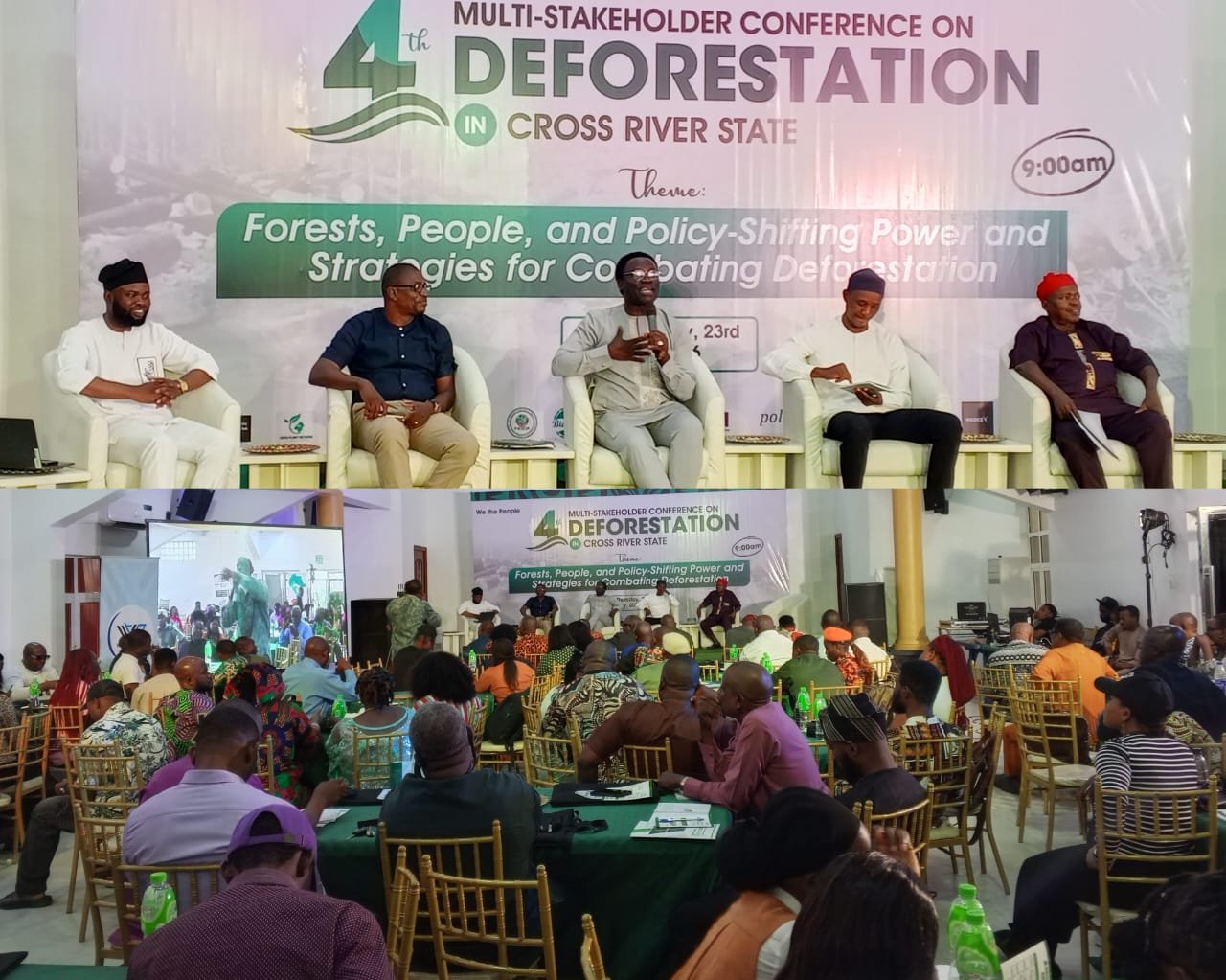
Environmental experts, legal practitioners, conservationists, and community leaders gathered in Calabar on Thursday for the 4th Multi-Stakeholder Conference on Deforestation in Cross River State, issuing an urgent call to action against illegal logging, destructive mining, and agricultural encroachment threatening Nigeria’s primary rainforest ecosystem.
The event, organized by civil society group We The People (WTP), provided a critical platform for key actors to review environmental degradation across the state, evaluate existing legal frameworks, and unveil strategic roadmaps to avert an ecological crisis.
Opening the conference, Ken Henshaw, Executive Director of We The People (WTP), highlighted the origin and decade-long effort behind the multi-stakeholder movement, reflecting on how unmitigated extraction almost wiped out the region’s biodiversity.
READ ALSO: ADC Chieftain Lists Lagos-Calabar Highway, Oil Fields as Key Determinants of Cross River’s Future
“This is the fourth edition in the journey we began in 2012. At that time, the forest was literally on a freefall. There was a forest moratorium in place that nobody expected or observed. Task forces that were established to stop illegal forest extraction had become the nemesis of deforestation. Law enforcement had become compromised. Non-indigenes and foreigners had effectively taken over our forests,” Henshaw lamented.
He noted that after initial media campaigns and direct advocacy failed to halt timber trafficking to states as far as Lagos, WTP partnered with organizations, academics, and forest-bearing communities to launch the yearly multi-stakeholder dialogue.
Highlighting a major milestone from the previous year’s assembly, Ken Henshaw announced the completion of a major policy document: Recommended Reviews for the Cross River Forestry Law 2010, produced following six months of technical consultations.
“The existing forestry law says almost nothing about climate change because it is an obsolete law,” he explained. “This review is the product of series of meetings, bringing together organizations, communities, academics, lawyers, legal experts, and conservationists through structured consultations.”
Giving alarming empirical data on habitat loss, Joseph Ntui, Conservator of Cross River National Park, warned that deforestation in the state is escalating rapidly, threatening globally endangered species like the Cross River gorilla, Nigeria chimpanzee, forest elephant, and pangolin.
“In the year 2025 alone, 14,000 hectares of tropical rainforest was lost in Cross River – and let me shock you, this resulted in the emission of 8 million tonnes of carbon dioxide,” Ntui revealed.
He detailed ongoing efforts by the National Park Service, which oversees 4,000 square kilometers across Akamkpa, Boki, and Obanliku Local Government Areas, stating that a force of roughly 250 armed rangers conducts regular patrols across park sectors.
“Between January and July 2026, over 80 park offenders – primarily illegal loggers, miners, and farm encroachers – were arrested, with over 60% successfully prosecuted and serving sentences in correctional facilities or paying court-mandated fines,” he stated.
Ntui noted that despite repeated engagements with state institutions since taking office in November 2024, state forest policy remains overly fixated on revenue generation rather than sustainable management.
Presenting a paper titled “Reforming the Cross River State Forestry Law: Policy Imperatives and Strategic Recommendations,” Dr. Martins Egot, Executive Director of PADIC Africa, stressed the critical role of the state in global environmental stability.
“Cross River State holds Nigeria’s most significant remaining tropical rainforest – part of the Lower Guinean forest ecosystem of West Africa. The State has already lost over 60% of its original forest cover, with former forest areas degrading into grassland,” Egot pointed out.
He identified primary drivers of degradation – including commercial cocoa expansion, weak statutory penalties, and institutional governance gaps – and advocated shifting indigenous communities from passive bystanders to official co-managers.
“Indigenous forest-bearing communities (such as Old and New Ekuri) are the frontline custodians of Cross River State’s rainforest heritage. The reformed law must transition local communities from passive subjects to statutory co-managers, guaranteeing transparent benefit-sharing and decision-making authority,” Egot stated.
However, the conference broadened its scope to tackle illegal mining, drawing direct parallels between Cross River’s emerging crisis and historical trends elsewhere in West Africa and Nigeria’s Middle Belt.
International environmental advocate, Daryl Bosu, delivered a paper titled “Illegal Mining, Deforestation and National Interests: Lessons from Ghana,” revealing that over 5,000 illegal miners have invaded Cross River over the past three years.
“Mining activities have been reported in Biase, Yakurr, and Akamkpa local government areas, including parts of the Cross River State National Park. Many miners are reportedly heavily armed and originate from Northern Nigeria and the Sahel,” Bosu stated.
He disclosed that 215 illegal miners are currently facing court prosecution in the state, while more than 2,000 others have been apprehended and deported. To prevent total ecological breakdown, Bosu urged Nigeria to adopt a four-phase roadmap through the establishment of legally designate non-negotiable protection zones free from mining.
He called for the mobilization coordination of inter-agency task forces such as NSCDC, Ministry of Mines, State Security, Financial Intelligence, amongst others. He also suggested registration of heavy equipment such as excavators, dredges and audit fuel supply chains in mining hotspots; while shifting focus from deporting low-level workers to prosecuting financial backers under Nigerian law with asset forfeiture.
Examining security dynamics, legal practitioner, Redzie Jugo Esq. presented “The Emerging Dynamics of Mining, Deforestation and Insecurity in Cross River State: Lessons from the Middle Belt of Nigeria.” Jugo warned policymakers that unchecked illegal mining frequently acts as a precursor to organized crime, armed conflict, and community displacement, advising immediate preventive security measures.
The multi-stakeholder conference concluded with an interactive panel session moderated by Ken Henshaw, featuring community leader Emmanuel Owan alongside conservationists Carlos Akpet and Daniel Kip.
The panel reiterated that protecting Cross River’s remaining rainforest canopy requires a three-pronged strategy: expedited passage of the modernized Forestry Law 2010 review, strict judicial accountability for illegal miners and loggers, and direct legal empowerment of indigenous host communities.