








By Emmanuel Onwuka
For Tolu Ajibola, winning a ₦3 million grant was more than an award. It was an opportunity to grow an agricultural business.
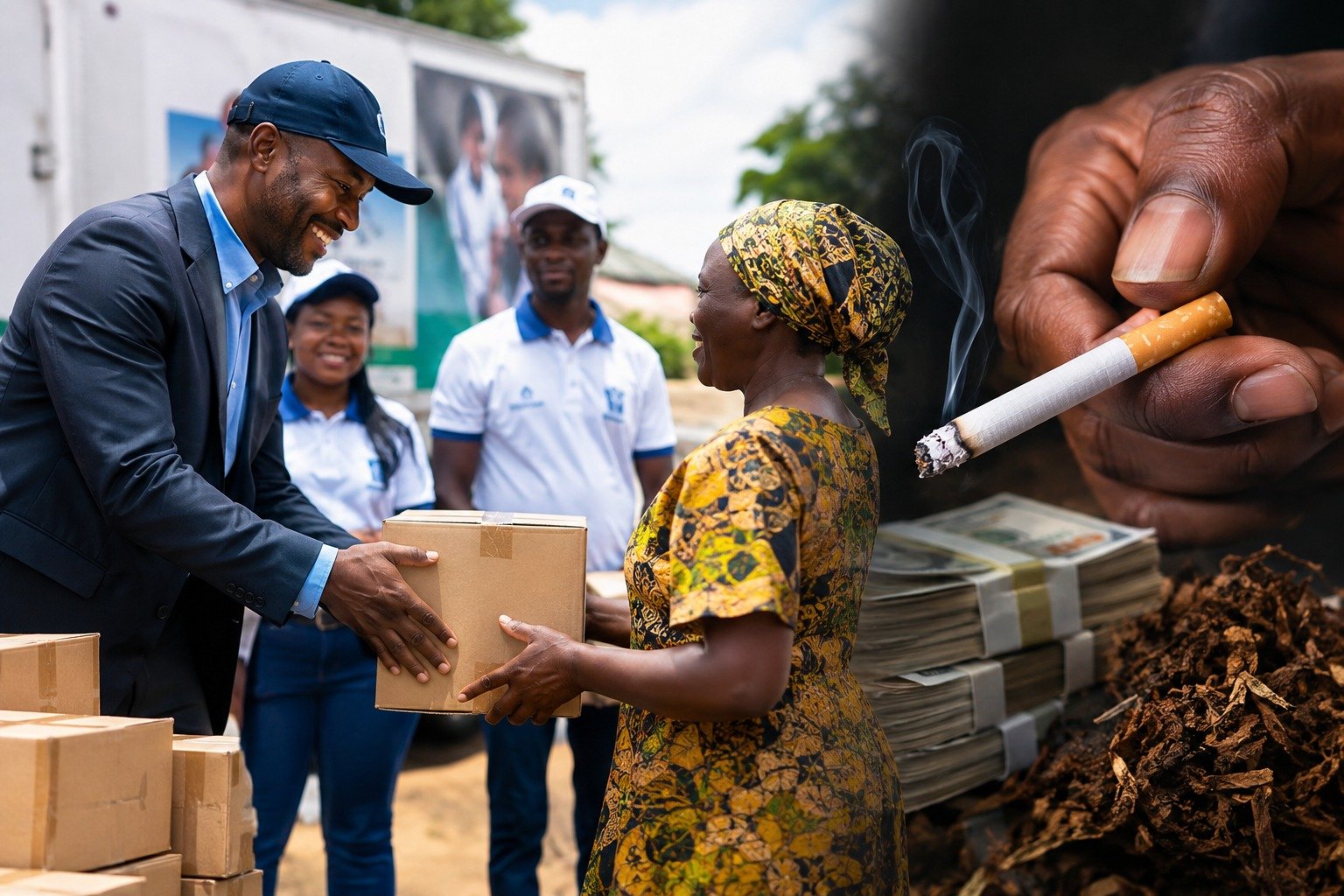
Ajibola was the winner of the 2024 Farmers for the Future programme backed by the British American Tobacco Nigeria Foundation (BATNF). The programme awarded a total of ₦10 million to six young Nigerian agripreneurs, with Ajibola receiving the top prize. He described the opportunity as helping him gain the skills, resources and confidence to scale his business. There is a reason to look at such support and see anything other than opportunity. That is precisely what makes tobacco industry philanthropy complicated. Behind the goodwill is a deadly product. This performative philanthropy often masks the industry’s primary objective: positioning itself as an indispensable economic stakeholder to derail legislative efforts, such as the National Tobacco Control Bill, under the guise of protecting foreign direct investment.
Across Nigeria, the tobacco industry continues to use investment as tool to influence policy heavily.
The British American Tobacco Nigeria Foundation, established by British American Tobacco Nigeria, says it has implemented more than 300 community projects across Nigeria, empowered more than 300,000 smallholder farmers, planted more than 500,000 trees and constructed more than 105 solar-powered boreholes. It also reports having reached 1.7 million beneficiaries and invested ₦4 billion in community development. But there is another side to the story that is less visible. Their reputational strategy to be seen as an organisation that creates opportunities.
The provision in Article 5.3 of the WHO Framework Convention on Tobacco Control, which Nigeria ratified in 2005 requires governments to protect tobacco-control policies from the commercial and other vested interests of the tobacco industry. Its implementation guidelines specifically call on countries to denormalise and regulate activities described as socially responsible by the tobacco industry, including corporate social responsibility.
The WHO FCTC Secretariat also identifies social responsibility initiatives alongside political lobbying and research funding as tactics that the tobacco industry can use to influence policy and undermine tobacco-control efforts. Nigeria has seen this problem before.
According to the Tobacco Industry Interference Index 2025, the tobacco industry’s corporate social responsibility (CSR) activities in Nigeria function as a Trojan horse for institutional legitimacy. BATNF has embedded itself in state development agendas by funding water, education, and agriculture projects, often in collaboration with ministries and agencies at both state and local government levels.
In Lagos, Oyo, and several other states, BATNF carried out projects ranging from fish farming support to borehole construction. These initiatives were publicly endorsed by state governors and government agencies, allowing the industry to repair its image, secure political access, and build goodwill, particularly among vulnerable communities. The active promotion of these CSR activities by government actors, rather than their rejection, reflects a disregard for WHO FCTC Article 5.3, which discourages such engagements because they undermine public health objectives.
In Nigeria, it is estimated that smoking was responsible for approximately 29,000 deaths every year, alongside about 816,000 disability-adjusted life years. It is also estimated that the annual economic burden attributable to tobacco is approximately 634 billion, based on 2019 figures.
It means thousands of Nigerian families losing fathers, mothers, spouses and siblings to diseases associated with tobacco use. It means patients are spending money on treatment. It means workers becoming too sick to work. It means families lose income when a breadwinner dies prematurely.
And it means that while one side of the industry may be financing a farm grant, a borehole or an entrepreneurship programme, another part of the same commercial system continues to make money from selling nicotine products. The contradiction is uncomfortable.
The Way Forward
The WHO’s position is clear: tobacco kills more than seven million people globally every year, while nicotine is highly addictive and particularly harmful to children, adolescents and young adults whose brains are still developing. The government should strictly implement and enforce stronger tobacco control measures, including increased tobacco taxation, larger health warnings, comprehensive marketing restrictions, smoke-free environments, and measures to protect young people from nicotine products, given the tobacco industry’s commercial interest in avoiding regulations that reduce tobacco consumption.
Youths, farmers, students and concerned Nigerians must stop seeing tobacco-linked foundation as belonging to an organisation that creates opportunities but as industry associated with addiction and disease. Nigerians cannot continue to accept those benefits at the price of making an industry whose products cause preventable disease appear indispensable to the country’s development.
Policymakers must stop seeing the tobacco industry as a valuable development partner but a commercial actor whose commercial interests violate public health.
Nigeria already bears a heavy human and economic burden from tobacco. Research estimates that smoking alone contributes to tens of thousands of deaths and hundreds of billions of naira in annual economic losses. Against that background, tobacco-industry philanthropy should not be celebrated because it looks like charity. It should be seen as an industry whose profits depend on selling an addictive and harmful product.