







By Kelvin Obambon
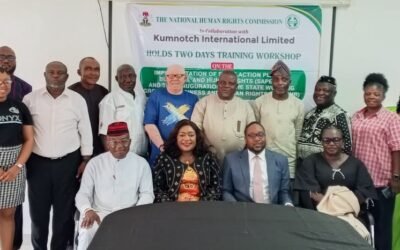
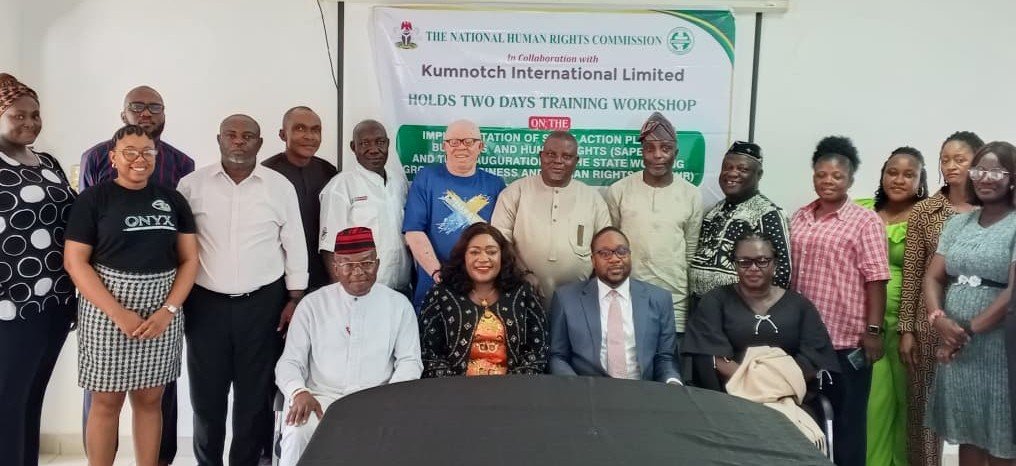
The National Human Rights Commission (NHRC) on Wednesday concluded a two-day training workshop on the implementation of the State Action Plan on Business and Human Rights (SAPBHR) and inaugurated the Cross River State Working Group on Business and Human Rights (SWGBHR) in Calabar.
The State Working Group is chaired by the Attorney General and Commissioner for Justice, Ededem Ani Esq. Dr Abigail Duke, Commissioner for Commerce, serves as alternate chairman, while Mr Remi Ajuga, state coordinator of the National Human Rights Commission, is the secretary. Other members are drawn from government ministries, departments and agencies, the organized labour as well as civil society organisations.
Dr Tony Ojukwu, Executive Secretary of the NHRC, who declared the workshop open, described it as timely, noting the growing national and global importance of the relationship between business activities, sustainable development and human rights protection.
READ ALSO: I have no interest becoming Awka traditional ruler – Jeff Nweke dismisses rumour
“Businesses are critical drivers of economic growth, employment generation, technological advancement and national development. However, economic development must not come at the expense of human dignity, fundamental freedoms, environmental sustainability and the rights of individuals and communities,” Ojukwu said.
He recalled that the United Nations Guiding Principles on Business and Human Rights rest on three pillars: the State duty to protect human rights, the corporate responsibility to respect human rights, and access to effective remedies for victims of business-related abuses.
Ojukwu whose address was read by the state coordinator of the NHRC, stressed that Ministries, Departments and Agencies have a central role in translating these principles into practice through policies, public procurement, licensing, investment decisions and development programmes.
“This training should go beyond the acquisition of theoretical knowledge. It should provide an opportunity for critical engagement, experience sharing and the identification of concrete institutional measures that will facilitate the implementation of the National Action Plan,” he said, charging participants to develop practical commitments that produce measurable outcomes.
In his remarks, Ededem Ani Esq welcomed the Commission on behalf of the Cross River State Government. He said the state remains open for business but insisted that investment must respect the rights of workers and communities.
“Business and human rights is simply remembering those behind the wheels before the bulldozers arrive, and not after,” Ani stated. He noted that the National Action Plan requires state-level replication of the National Working Group and emphasized that the plan “cannot work without us.”
Ani linked the initiative to constitutional duties to safeguard the security and welfare of the people, the Land Use Act’s trusteeship of land, and obligations under the African Charter on Human and Peoples’ Rights. He called for inclusive participation by traders, farmers, union leaders and chief executives, and for every commitment to carry “a name, a date, and a way of knowing whether it has been done.”
Dr Abigail Duke, speaking as alternate chairman, said the Ministry of Commerce’s mandate to promote ease of doing business cannot be separated from the people who make business possible.
“We cannot do business without also recognising the human being that does the business. Without the human being, I don’t think the business will do itself,” she said. Duke described Cross River as pursuing a people-oriented government and said the state is advancing a trade policy to attract both local and external investors while ensuring that policies benefit the business community and residents.
The workshop, held Tuesday 17 and Wednesday 18 November 2026, brought together officials from MDAs and other stakeholders to strengthen coordination, human rights due diligence, monitoring of business activities and access to remedies.