









By Ovat Abeng
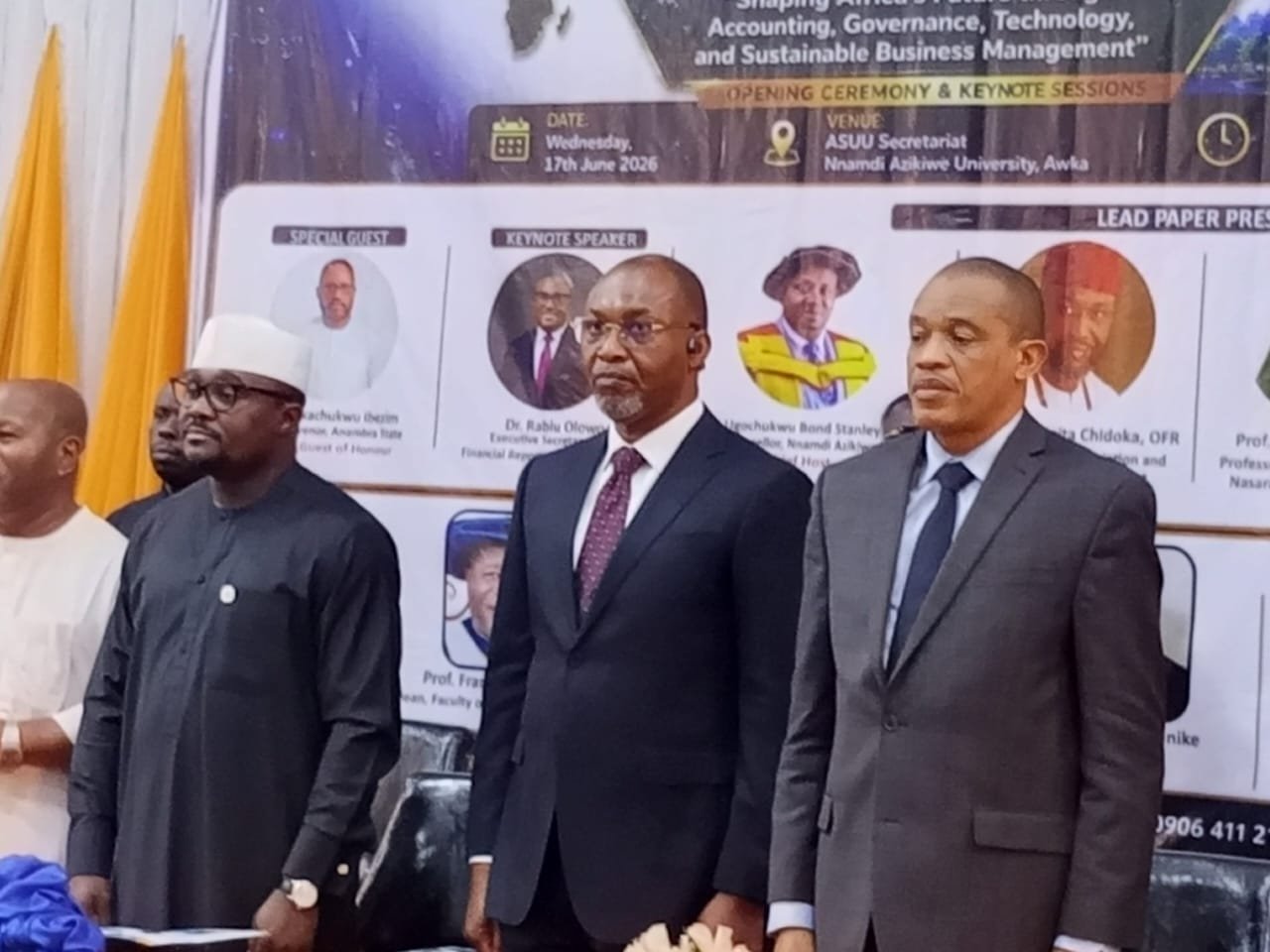
The keynote speaker at the just concluded 7th International Conference (HYBRID) 2026 organized by the Department of Accountancy, Faculty of Management Sciences, Nnamdi Azikiwe University Awka, Anambra State, and the Executive Secretary of Financial Reporting Council of Nigeria (FRC), Dr Rabiu Olowo, has backed the plan creation of Faculty of Accountancy from it existing Faculty of Management Sciences by the University management.
Olowo said the proposed faculty if fully implemented will not only attract more students to the Varsity but will create job opportunities for the unemployed Nigerians.
He promised to partner with the University to actualize the plan.
Recall that the Vice Chancellor of Nnamdi Azikiwe University Awka, Prof Ugochukwu Bond Stanley Anyahie, announced the Varsity’s plan to create Faculty of Accountancy from the existing Faculty of Management Sciences, during the conference, held at ASUU Secretariat in Awka on Wednesday, June 17th, 2026.
READ ALSO: Soludo’s wife urges stakeholders to prioritize healthcare providers welfare
Anyahie noted that the academic restructuring is to unbundle the Varsity’s Faculty of Management Sciences.
He said It is an upgrade that is not limited to the Accountancy but an upgrade that is limited to the University as whole in recognition to the growth, the varsity is witnessed and also in appreciation of the life, late Dr Nnamdi Azikiwe lives.
The VC while appreciating Dr Olowo for supporting the conference with a sum of 5 million naira, noted further than the new development is among other plans his administration has mapped out to make Nnamdi Azikiwe University attained it International best standard.
Speaking further at the conference with the topic; Shaping Africa’s Future through Accounting, Governance, Technology and Sustainable Business Management,” the FRC’S boss, called on African scholars, practitioners, policymakers, regulators, and industry leaders to reflect on issues that can shape a future that is prosperous, accountable, technologically advanced, environmentally sustainable, and socially inclusive.
According to him, “It reflects the reality that the challenges confronting Africa today can no longer be addressed through isolated interventions.
“The complexity of modern economic systems requires integrated solutions. Accounting, governance, technology, and sustainability are no longer independent disciplines operating in separate spheres.They have become interconnected drivers of development whose collective impact will largely determine the trajectory of Africa’s future.
“The future of Africa has become one of the most discussed subjects within global development circles.
“This growing attention is not accidental. Africa represents the world’s youngest continent, possesses some of the largest reserves of natural resources globally, and is increasingly emerging as a critical player in global economic and geopolitical conversations.
According to projections by the United Nations, Africa’s population is expected to exceed 2.5 billion people by 2050, accounting for approximately one-quarter of the world’s population and by the end of this century, more than one-third of the world’s population could be African.
“These figures present extraordinary opportunities for economic growth, innovation, entrepreneurship, and market expansion.
“Yet demographic advantage alone does not guarantee prosperity. History offers numerous examples of nations endowed with abundant resources and favourable demographics that nevertheless failed to achieve sustainable development.
“Conversely, countries with relatively limited resources have transformed themselves into economic powerhouses through effective institutions, technology, sound governance, strategic investments in human capital, and commitment to transparency and accountability.
“The lesson is clear. The future of Africa will not be determined solely by what lies beneath its soil or by the size of its population. It will be determined by the quality of its institutions, the effectiveness of its governance systems, the credibility of its reporting frameworks, and the sustainability of its development strategies.
“Africa’s challenge is therefore not simply to adopt technology but to ensure that technological innovation is guided by ethical principles, effective regulation, and sound governance frameworks.
Sustainability as a Strategic Imperative for African Development.
“Accounting as a Catalyst for Economic Transformation has traditionally been perceived as the process of recording, classifying, and reporting financial transactions. While this description is technically correct, it does not fully capture the transformative role that accounting plays in modern economies.
“In reality, accounting is one of the most powerful instruments for economic development because it provides the information infrastructure upon which markets, institutions, and governments depend.”
Every successful economy is built on trust. Investors invest because they trust the information available to them. Lenders provide credit because they trust financial reports and disclosures. Governments formulate policies because they trust economic data. Citizens place confidence in institutions when transparency and accountability are evident. Accounting, therefore, serves as a bridge between economic activity and public confidence.
In the absence of reliable financial information, markets become inefficient. Capital is misallocated. Investors become reluctant to commit resources. Economic opportunities are lost. The consequences of poor financial reporting have been demonstrated repeatedly through corporate collapses and financial scandals across different parts of the world. In nearly every instance, the erosion of confidence preceded the destruction of value.
Research consistently demonstrates a positive relationship between financial reporting quality and economic development. Countries with stronger reporting frameworks often attract higher levels of foreign direct investment because investors are better able to assess risks and opportunities.
High-quality financial reporting reduces information asymmetry, lowers the cost of capital, improves corporate performance, and enhances market efficiency.
“These benefits extend beyond individual organisations and contribute to broader national development objectives,
“The Financial Reporting Council continues to play a leading role in promoting high-quality financial reporting through the adoption and enforcement of internationally recognised standards.
“These efforts contribute to improved transparency, greater comparability of financial information, and enhanced confidence among investors and stakeholders.
“The Council’s work in advancing corporate governance is equally important. Through the Nigerian Code of Corporate Governance 2018, organisations are encouraged to adopt governance practices that promote accountability, ethical leadership, effective risk management, and sustainable value creation.
“The Africa we desire is achievable. It is an Africa where institutions command trust, where businesses create sustainable value, where technology serves humanity, where governance inspires confidence, and where economic growth translates into improved quality of life for all and the responsibility for building that Africa belongs to us, the opportunity is before us and the time to act is now, Olowo advocated.
The event that featured award presentation to Dr Olowo and other deserving stakeholders, also have in attendance, the former Aviation Minister, Chief Osita Chidoka, Major General Charles Ofoche as lead paper presenters and Mr Christian Udechukwu, special Adviser to governor Chukwuma Charles Soludo on Investment as chairman of the occasion.