







By Our Reporter
A security expert has argued that Nigeria’s persistent insecurity is fundamentally a crisis of broken relationships and weakened social solidarity, proposing a “complementary security architecture” rooted in shared responsibility and community participation.
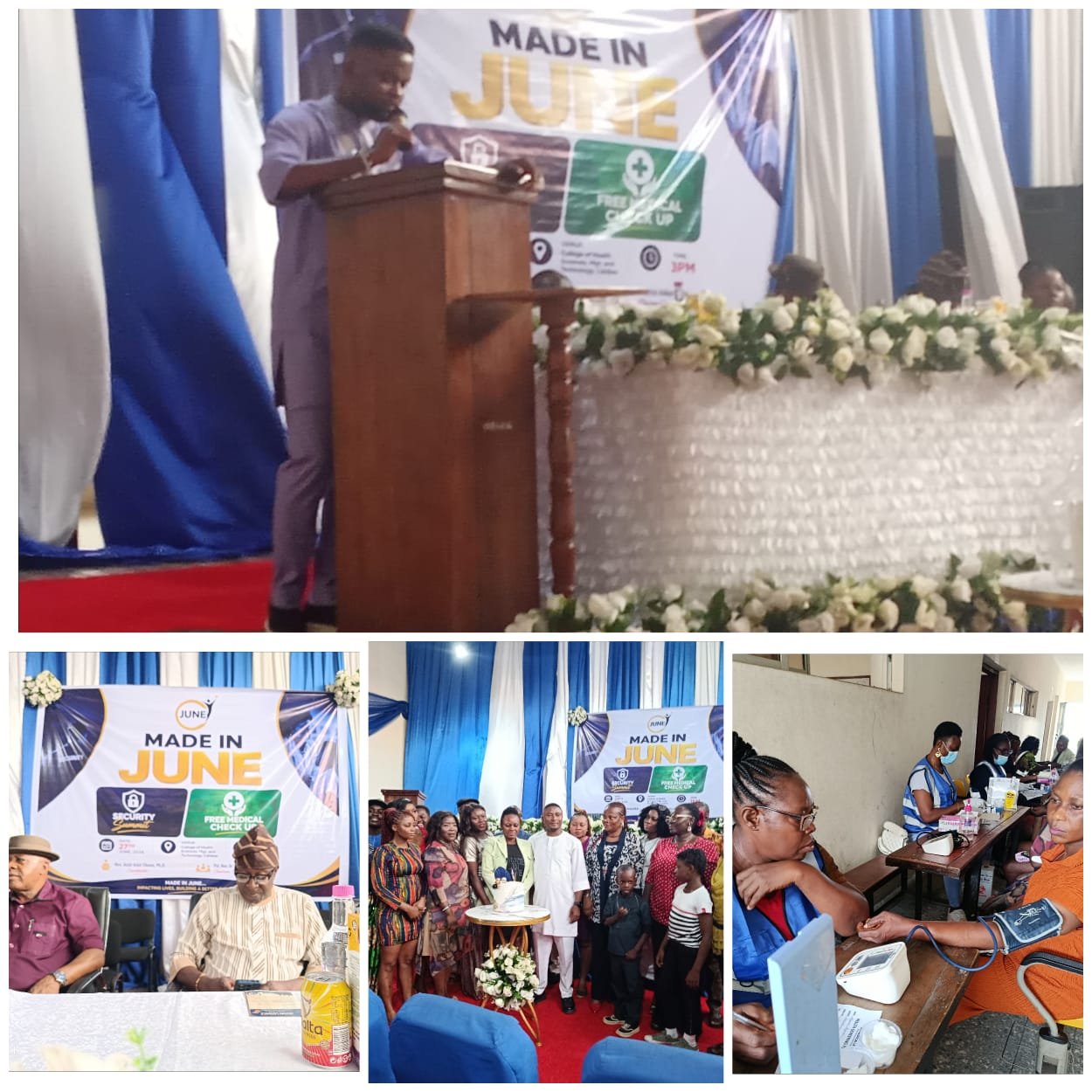
Dr. Efio-Ita Nyok an alumnus of Institute of Security and Forensic Studies Nigeria (SFSN), Abuja made the submission in a paper titled “Complementary Reflection and the Quest for National Security in Nigeria: Building Bridges for Sustainable Peace through an Ibuanyidanda Framework,” delivered at the maiden “Made in June” Security Summit and Medical Outreach held on Saturday at the College of Health Sciences Management and Technology, Calabar.
Drawing on Innocent I. Asouzu’s philosophy of Complementary Reflection (Ibuanyidanda), Dr. Nyok contended that insecurity stems largely from fractured social relationships, exclusion, and the failure to appreciate every person as a “missing link”.
READ ALSO: How the NIMC Act 2026 Could Transform Social Protection in Nigeria
“Nigerian security challenges demand responses that extend beyond military and law enforcement measures,” the paper read in its abstract. “Sustainable national security depends on recognising the interconnectedness of citizens, institutions, and communities”.
The social and political philosopher maintained that Nigeria’s security challenges—including terrorism, banditry, kidnapping, communal conflicts, cybercrime, and militancy—are better understood as symptoms of a deeper crisis rather than the crisis itself.
“Beneath these visible threats lies a gradual erosion of trust, justice, and social cohesion, fuelled by corruption, poverty, unemployment, political exclusion, and identity-based divisions,” he wrote.
From the perspective of Complementary Reflection, he explained, these conditions reflect a breakdown in the complementary relationships that ought to bind citizens, institutions, and communities together in pursuit of the common good.
The expert called for a shift from “government security” to “collective security,” arguing that lasting peace cannot be legislated or militarised into existence.
“A Complementary National Security Architecture recognises that security is neither the exclusive responsibility of government nor the sole burden of security agencies,” Dr. Nyok stated. “Rather, it is a shared enterprise involving the state, traditional and religious institutions, civil society, the media, the private sector, and citizens”.
He emphasised that “every individual, institution, and community constitutes an indispensable ‘missing link’ in the pursuit of the common good,” and that “the security of one is inseparable from the security of all”.
The paper concluded that securing Nigeria requires more than weapons, surveillance, or legislation.
“Ultimately, securing Nigeria requires… a renewed national consciousness rooted in the ethics of complementarity,” Dr. Nyok argued. “The future of the nation depends on our willingness to recognise that the security of one community is inseparable from the security of another, and that no individual or institution can secure Nigeria in isolation”.
The summit, organised by the “Made in June” group comprising June-born indigenes of and residents in Cross River State, also featured a keynote address by the Coordinator, Dr. Adat Adat Obona, and a free medical outreach for participants.