










By Vincent Dania
The NIMC Act was signed into law by the President of Nigeria on June 26, 2026. Nigeria now has a new identity law.
At first glance, many Nigerians may see the Act as another step in the long journey of NIN registration. But it is bigger than that. The Act modernises Nigeria’s identity ecosystem for a digital age. It strengthens the legal foundation for identity management and supports a secure framework through which people can access public services, participate in the digital economy, and verify their identities across sectors.
One of its most important provisions is that it makes NIMC the Root Certification Authority for Nigeria’s national public key infrastructure. In simple terms, NIMC now sits at the centre of digital trust in Nigeria. It provides the trusted foundation for digital certificates, electronic signatures, secure online transactions, and verified digital identities.
READ ALSO: Sports Is Nigeria’s Greatest Weapon Against Drug Abuse – Orok Duke
This may sound technical, but it matters. In a digital economy, trust is everything. Before a person signs a document electronically, opens an account online, accesses a government portal, or completes a secure transaction, there must be a system that confirms that the person, document, platform, or transaction is genuine.
These are important objectives
But from my perspective, the most significant opportunity presented by the NIMC Act 2026 lies in what it could mean for social protection.
One of the biggest challenges facing social protection in Nigeria is not always a lack of programmes or resources. Often, it is the difficulty of identifying, locating, and supporting the people who need assistance the most.
Millions of Nigerians work in the informal economy, lack formal documentation, or remain outside many of the systems through which government delivers support.
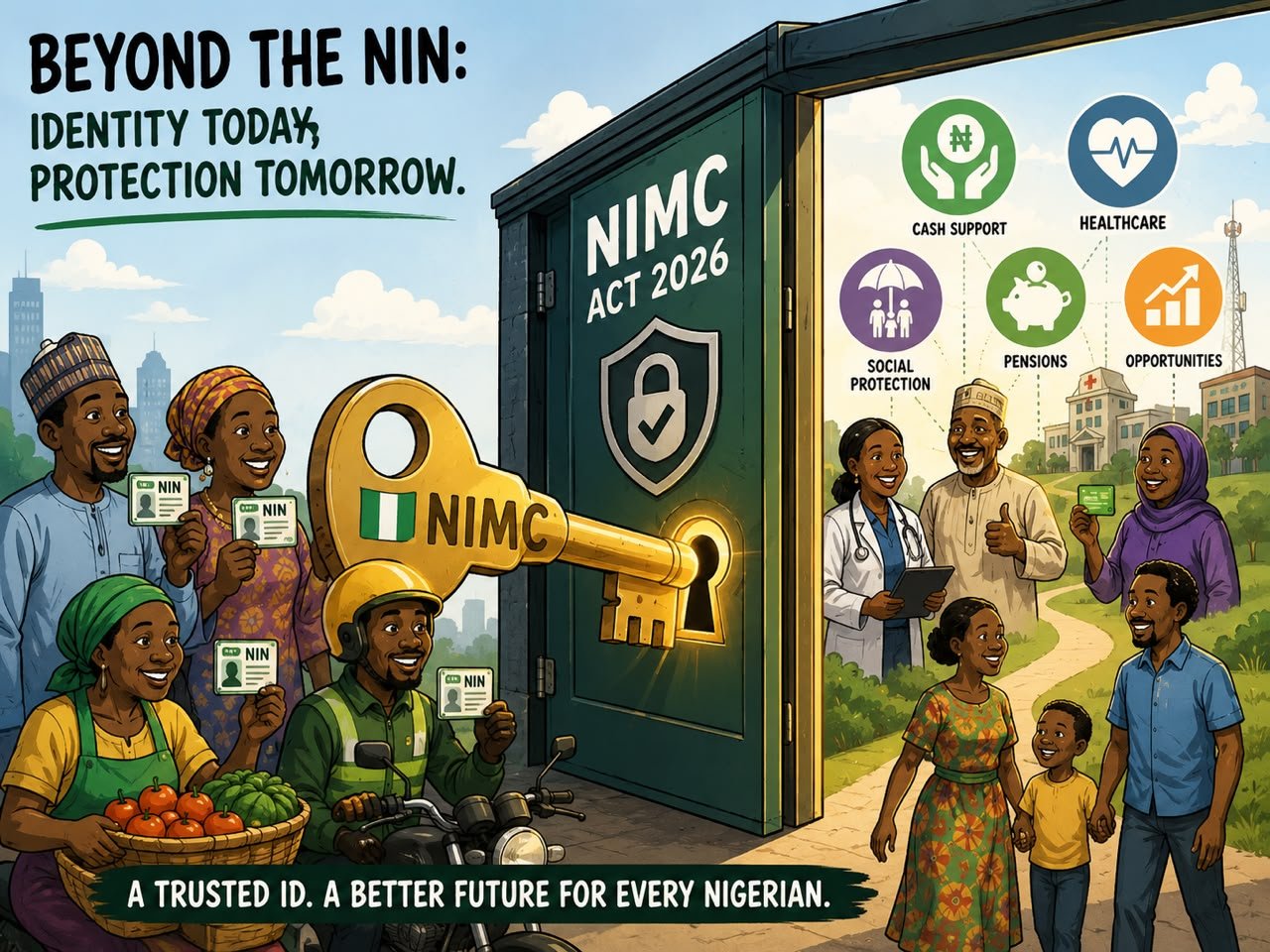
In a country where vulnerability often exists beyond the reach of formal institutions, identity is more than verification. It can become a gateway to inclusion. Viewed this way, the NIMC Act 2026 is not simply an identity law. It is a law with the potential to strengthen the foundation for a more inclusive, responsive, and adaptive social protection system.
Why Identity Matters
At its core, social protection is about ensuring that people receive support when they need it most. Whether it is a cash transfer, health insurance, emergency assistance, pension support, or a livelihood programme, government must first be able to identify the people it intends to serve.
When governments cannot reliably identify beneficiaries, programmes become vulnerable to fraud, duplication, exclusion, and inefficiency. Some people receive benefits they are not entitled to, while others who genuinely need support are left behind.
A strong identity system helps address these challenges. It verifies that a person is who they claim to be, reduces duplicate registrations, and improves coordination across programmes. It could help ensure that benefits reach intended recipients more efficiently and make it easier for people to access social assistance, health insurance, pension schemes, emergency support, and other services regardless of location.
Identity Is the Foundation, Not the Solution
While the NIMC Act 2026 presents a significant opportunity, identity alone cannot solve poverty or vulnerability.
A digital identity can help government know who you are. It cannot, by itself, improve your income, create jobs, provide healthcare, or protect you from economic shocks.
This is important in Nigeria, where most people earn their living in the informal economy. Millions of traders, artisans, transport workers, farmers, domestic workers, and self-employed people operate outside formal employment systems. Many have no employer-sponsored pension, health insurance, or unemployment protection.
A National Identification Number can help identify these workers, but identification alone does not guarantee protection.
The challenge becomes even more important as work changes. Technology, artificial intelligence, digital platforms, and automation are transforming labour markets. For many workers, especially those in low-income and informal occupations, future risks may emerge gradually through declining earnings, unstable work arrangements, reduced business opportunities, and increased competition.
This means Nigeria’s social protection system must do more than identify people. It must also understand and respond to changing forms of vulnerability. Identity is the starting point. It is not the finish line.
From Identity to Adaptive Social Protection
The greatest opportunity presented by the NIMC Act 2026 is the possibility of using identity as the foundation for a more adaptive and responsive social protection architecture.
Traditionally, social protection systems focus on identifying people who are already poor and providing support after hardship occurs. Increasingly, however, governments must anticipate and respond to risks before they push households into crisis.
This matters in Nigeria, where vulnerability is shaped by illness, flooding, displacement, inflation, crop failure, insecurity, economic downturns, and changes in labour market demand.
To respond effectively, social protection systems must identify vulnerable populations, understand changing circumstances, and deliver support quickly when needed. This is where digital identity can play a transformative role.
A trusted identity system can help government build more accurate social registries, improve targeting, reduce duplication, and coordinate support across agencies. It can also make it easier to connect citizens to financial services, health insurance, pension schemes, skills development programmes, and emergency assistance.
The real measure of success will not be how many identity numbers are issued. It will be whether the system helps government respond more effectively when people face hardship and whether vulnerable Nigerians can access support when they need it most.
The Risks We Must Avoid
While the NIMC Act 2026 presents enormous opportunities, its success is far from guaranteed. Like many ambitious reforms, the difference between success and failure will depend largely on implementation.
One risk is exclusion. The people who stand to benefit most from social protection are often the hardest to reach. They may live in remote communities, lack formal documentation, have limited digital literacy, or face barriers to registration. If not carefully designed, digital systems can unintentionally exclude the very people they are intended to help.
Another concern is privacy and data security. Citizens must have confidence that their personal information is secure and used responsibly.
There is also the challenge of coordination. Identity systems alone do not deliver social protection. The real benefits will only emerge when identity infrastructure is connected to social registers, financial services, healthcare systems, pension programmes, and emergency response mechanisms.
These challenges should not discourage reform. They highlight the importance of getting implementation right. The goal should not simply be to register more people. The goal should be to ensure that every Nigerian can use a trusted identity to access opportunities, services, and support when they need them most.
Conclusion
The NIMC Act 2026 has the potential to be remembered as more than an identity reform.
If implemented effectively, it could become a foundational building block for a more inclusive digital economy, more efficient public services, and a stronger social protection system.
For decades, many vulnerable Nigerians have remained largely invisible to formal systems. They have struggled to access financial services, social programmes, health insurance, pensions, and other support not because they were undeserving, but because the systems designed to serve them could not reliably identify and reach them.
The new law offers an opportunity to change that.
But the true measure of success will not be the number of NINs issued or databases integrated. It will be whether the system helps government identify vulnerability, respond to shocks, and connect people to opportunities and support when they need them most.
Identity is not an end in itself. Its real value lies in helping ensure that every Nigerian can be seen, recognised, included, and supported.
The NIMC Act 2026 opens that door. What Nigeria chooses to build beyond it may determine whether this reform becomes a technological upgrade or a genuine transformation in the lives of millions of citizens.
Vincent Dania is a PhD researcher on AI and labour market risks in high-informality economies at the Institute of Social Policy and Strategic Studies, Nnamdi Azikiwe University, Awka.