







By JOF Media
The Joseph Ogogo Foundation (JOF) is steadily redefining what community development can achieve when humanitarian intervention goes beyond immediate relief to address the interconnected challenges confronting rural communities.
Across Obanliku Local Government Area of Cross River State, the Foundation has embarked on a series of carefully targeted interventions designed to improve access to education, restore dignity among vulnerable pupils, promote safer communities and strengthen the infrastructure required for sustainable development.
At the heart of the Foundation’s intervention philosophy is a simple conviction: a child cannot learn effectively when poverty prevents the payment of school fees, when there are no basic learning materials, or when the journey home from school is unsafe.
READ ALSO: Cross River flags off distribution of fertilizers to 8,000 farmers
It is this understanding that has shaped the Joseph Ogogo Foundation’s journey from educational intervention to broader community development, a journey in service to humanity and to the glory of God.
THE FIRST INTERVENTION: LAYING THE FOUNDATION FOR EDUCATIONAL ACCESS
The Foundation’s First Intervention Programme began by confronting one of the most immediate barriers to rural education: financial hardship.
For many families across Obanliku, meeting the cost of school fees, exercise books, writing materials and other basic educational requirements for several children can be overwhelming. The resulting pressure often forces parents to choose which children can remain in school, while others are left behind.
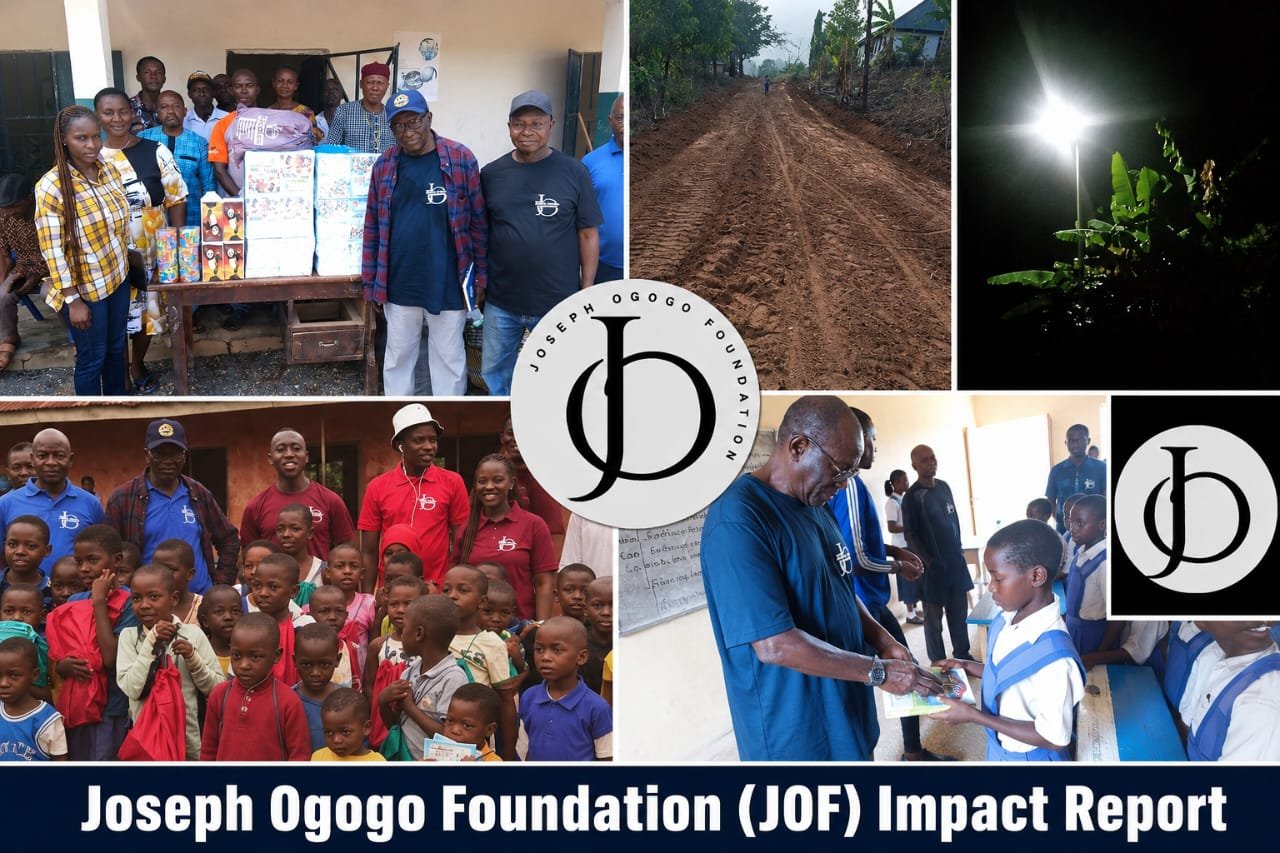
JOF responded by launching its First Intervention Programme at Bukemanya Government Primary School and 10 other schools, with the objective of ensuring that children were not denied education simply because their families could not afford the basic requirements.
The intervention provided critical educational support and helped remove some of the immediate obstacles standing between rural pupils and the classroom.
RESTORING CONFIDENCE AND ENCOURAGING ATTENDANCE
Beyond the physical materials provided, the First Intervention Programme had a wider social impact.
By reducing the financial burden on families and ensuring that pupils had the basic materials required for learning, the Foundation helped restore confidence among children and their parents.
The intervention also contributed to renewed interest in schooling, with improved classroom attendance and a stronger sense of stability within participating communities.
For JOF, however, the first intervention was not an end in itself. It was the beginning of a continuing commitment to rural education.
THE SECOND INTERVENTION: EXPANDING THE REACH AND RESTORING DIGNITY
Building on the foundation established during the first phase, the Second Intervention Programme expanded the Foundation’s educational support to reach more families and address a broader range of pupils’ needs.
The intervention recognised that educational access is not merely about getting a child into a classroom. Children must also have the tools, appearance and confidence required to participate fully in the learning environment.
JOF therefore provided pupils with school uniforms, exercise books, writing materials and other essential educational resources.
TUITION RELIEF FOR FAMILIES
A significant component of the second phase was the Foundation’s decision to fully fund the school tuition fees of primary and pre-primary pupils at Bukemanya Government Primary School.
This direct tuition relief lifted a major financial burden from parents and guardians, allowing children to remain in school without the constant threat of withdrawal occasioned by unpaid fees.
For families already struggling with the rising cost of living, the intervention represented more than financial assistance. It restored hope and created a greater sense of security around their children’s education.
LEARNING WITH DIGNITY
JOF also recognised the psychological and social dimensions of poverty.
A child who attends school without a uniform, books or basic writing materials may feel different from classmates who have them. By providing pupils with new uniforms and comprehensive learning materials, the Foundation sought to eliminate that stigma and create a more inclusive learning environment.
The objective was clear: every child deserves to learn with dignity, confidence and a sense of belonging.
THE THIRD INTERVENTION: CONSOLIDATING A SUSTAINABLE IMPACT
The Third Intervention Programme marked another important milestone in the Foundation’s journey.
Rather than treating each intervention as an isolated humanitarian exercise, JOF used the third phase to consolidate previous gains while broadening its engagement with communities across Obanliku.
Educational support was renewed to ensure that children who had previously benefited from the Foundation’s interventions did not suddenly lose access to school because assistance had ended.
This continuity is central to JOF’s approach.
The Foundation believes that sustainable development requires consistency. Bringing a child into the school system is important; keeping that child in school and creating an environment where learning can thrive is even more important.
REACHING COMMUNITIES BEYOND THE MOTORABLE ROADS
One of the remarkable aspects of the third intervention was the Foundation’s determination to reach pupils in communities where access is difficult.
Educational materials were sent to schools located in communities that are not readily accessible by motorable roads. Feedback from those communities confirmed that the materials successfully reached the pupils for whom they were intended.
That feedback reinforced JOF’s commitment to ensuring that geographical isolation does not become a permanent barrier to opportunity.
HUMANITARIAN SUPPORT AND COMMUNITY DIALOGUE
The third intervention also extended beyond the distribution of educational materials.
JOF engaged local elders, teachers, community leaders and other stakeholders to better understand emerging needs and develop a continuing feedback mechanism.
This approach allows the Foundation to listen to communities rather than simply prescribe solutions for them.
Through dialogue and direct engagement, JOF continues to identify areas where targeted interventions can produce meaningful and lasting results.
ILLUMINATING THE WAY: SOLAR STREET LIGHT PROJECT
Education does not end when the school bell rings.
For children returning home after school and for residents going about their daily activities after sunset, safe and illuminated pathways are essential to community wellbeing.
Recognising this reality, the Joseph Ogogo Foundation (JOF) expanded its intervention beyond education into public infrastructure by installing solar-powered street lights along key highways and major community thoroughfares.
The project is designed to improve visibility, enhance night-time accessibility and contribute to safer community environments.
The solar-powered nature of the installations also provides a practical and sustainable alternative in areas where conventional electricity supply may be unreliable or unavailable.
For JOF, the street-light project represents another dimension of its humanitarian philosophy: development must improve not only what happens inside the classroom but also the environment in which children and families live.
CONNECTING COMMUNITIES: ROADS, MOBILITY AND DEVELOPMENT
Physical isolation remains a major challenge to rural development.
Poor road networks can make it difficult for farmers to transport agricultural produce to markets, prevent residents from accessing essential services and increase the difficulty of responding to emergencies.
The Joseph Ogogo Foundation has therefore identified road connectivity as an important component of its broader community-development agenda.
By supporting local road maintenance initiatives and advocating improvements along important transit routes, JOF is working towards better mobility for families, farmers, pupils and other residents.
Particular attention has been given to communities including Bukemanya and Ketting Bendi, where improved connectivity can strengthen links with surrounding communities and urban centres.
BRIDGING THE DIGITAL DIVIDE
In today’s world, development is increasingly connected to access to information and communication technology.
Reliable mobile and network connectivity can provide opportunities for education, entrepreneurship, financial inclusion, communication and access to vital information.
JOF recognises that rural communities cannot afford to remain disconnected from the digital economy.
Consequently, the Foundation continues to work towards improved digital and network connectivity across underserved communities, laying the groundwork for greater digital inclusion, literacy and economic opportunity.
FROM RELIEF TO SUSTAINABLE SELF-RELIANCE
The journey of the Joseph Ogogo Foundation demonstrates an evolving approach to humanitarian service.
It began with a pressing question: How can vulnerable children be helped to remain in school?
The answer led to the provision of school fees, uniforms, exercise books and writing materials.
But the Foundation’s vision did not stop there.
It progressed towards another question: What kind of community environment enables children and families to thrive?
That question opened the door to interventions in public safety, solar street lighting, roads, mobility and digital connectivity.
The result is a broader development model that seeks to address immediate needs while laying the foundation for long-term self-reliance.
EVERY INTERVENTION TELLS A STORY
•Every school fee paid represents a child given another opportunity to learn.
•Every uniform provided restores a measure of dignity.
•Every exercise book and writing material supplied removes another barrier to education.
•Every solar street light installed helps illuminate a pathway and strengthen community safety.
•Every effort to improve a road creates better opportunities for movement, trade and access to essential services.
And every effort to improve digital connectivity opens another window to the wider world.
Together, these interventions tell a larger story, the story of communities being empowered one intervention at a time.
FAITH AND SPIRITUALITY: BUILDING FOR GOD, SERVING HUMANITY
The impact of the Joseph Ogogo Foundation extends beyond classrooms, community roads and solar-powered street lights. At the heart of its philosophy is a deep commitment to faith, spirituality and service to God and humanity.
In a remarkable demonstration of this commitment, the Joseph Ogogo Foundation undertook the construction of the magnificent St. Justine’s Catholic Church, building the worship centre from the ground up and ultimately handing it over to the Catholic Church community.
The project stands as one of the Foundation’s most significant expressions of faith and service. Through its scale, architectural beauty and spiritual significance, the Church has been widely regarded as one of the most beautiful worship centres within the Catholic Diocese of Ogoja.
A LEGACY BUILT ON FAITH
The construction and official handover of St. Justine’s Catholic Church represent far more than the completion of a physical structure. It reflects a belief that sustainable community development must also nurture the spiritual and moral foundations upon which communities are built.
By providing a befitting place of worship, the Joseph Ogogo Foundation has contributed to creating a permanent space where the Catholic faithful can gather in prayer, celebrate their faith, strengthen fellowship and pass spiritual values from one generation to another.
The church therefore forms an important part of the Foundation’s wider impact story, a legacy that combines faith, compassion, community and service.
GIVING AS A FORCE FOR COLLECTIVE PROGRESS
Through the Joseph Ogogo Foundation, Joseph Ogogo has extended his influence beyond individual acts of generosity to champion broader community-development initiatives and support vulnerable members of society.
The Foundation has consequently evolved into a symbol of his enduring belief in the transformative power of giving and the importance of collective progress.
Its interventions demonstrate that meaningful philanthropy is not limited to providing immediate assistance. It can create institutions, strengthen communities, restore dignity, open opportunities and leave behind assets that continue to serve people long after the initial intervention.
From supporting children in rural schools to providing learning materials and tuition relief; from illuminating communities with solar street lights to supporting improved road and digital connectivity; and from humanitarian assistance to building a magnificent house of worship, the Foundation’s interventions reflect one overarching philosophy:
•To use available resources to touch lives, strengthen communities and glorify God through service to humanity.
A LEGACY THAT TRANSCENDS PROJECTS
The story of the Joseph Ogogo Foundation is therefore not simply a catalogue of projects completed or beneficiaries reached. It is a story of a developing legacy.
Every intervention carries a human dimension. Every completed project represents an investment in people. Every act of giving seeks to create an opportunity for someone else to live, learn, worship and thrive with greater dignity.
The magnificent St. Justine’s Catholic Church stands alongside the Foundation’s educational and community-development interventions as a lasting testament to that philosophy.
Together, these achievements demonstrate that true impact is measured not only by what is built, but by the lives, communities and generations that are positively transformed by what is built.
And in that continuing journey of service, the Joseph Ogogo Foundation remains committed to transforming communities, restoring hope, empowering generations and giving glory to God.
A JOURNEY IN SERVICE TO HUMANITY — TO THE GLORY OF GOD
For the Joseph Ogogo Foundation, community development is more than a programme of activities. It is a responsibility to humanity and an expression of compassion, service and faith.
The Foundation’s journey from its First Intervention Programme to its latest infrastructure initiatives reflects a commitment to touching lives in practical ways and creating opportunities where they are most needed.
The vision is not simply to provide temporary relief but to help build communities where children can attend school, families can live with greater dignity, roads can connect communities, streets can be safer after dark and residents can participate in an increasingly digital world.
As the Foundation reflects on the milestones achieved so far, it remains grateful to the traditional and community leaders, teachers, volunteers, beneficiaries, partners and supporters whose contributions continue to make the work possible.
The journey continues.
And with every intervention, the Joseph Ogogo Foundation is helping to build stronger, safer, better-educated and more resilient communities for generations to come.
TRANSFORMING COMMUNITIES. RESTORING HOPE. EMPOWERING GENERATIONS.
Joseph Ogogo Foundation — serving humanity, transforming communities and giving glory to God.
For more information and enquiries, visit the Joseph Ogogo Foundation website:
www.josephogogofoundation.org