









By Kelvin Obambon
The Chief Medical Director of the University of Calabar Teaching Hospital (UCTH), Prof. Ikpeme A. Ikpeme, has highlighted the hospital’s growing capacity to handle complex medical procedures, positioning the institution as a leading tertiary health hub in the West African sub-region.
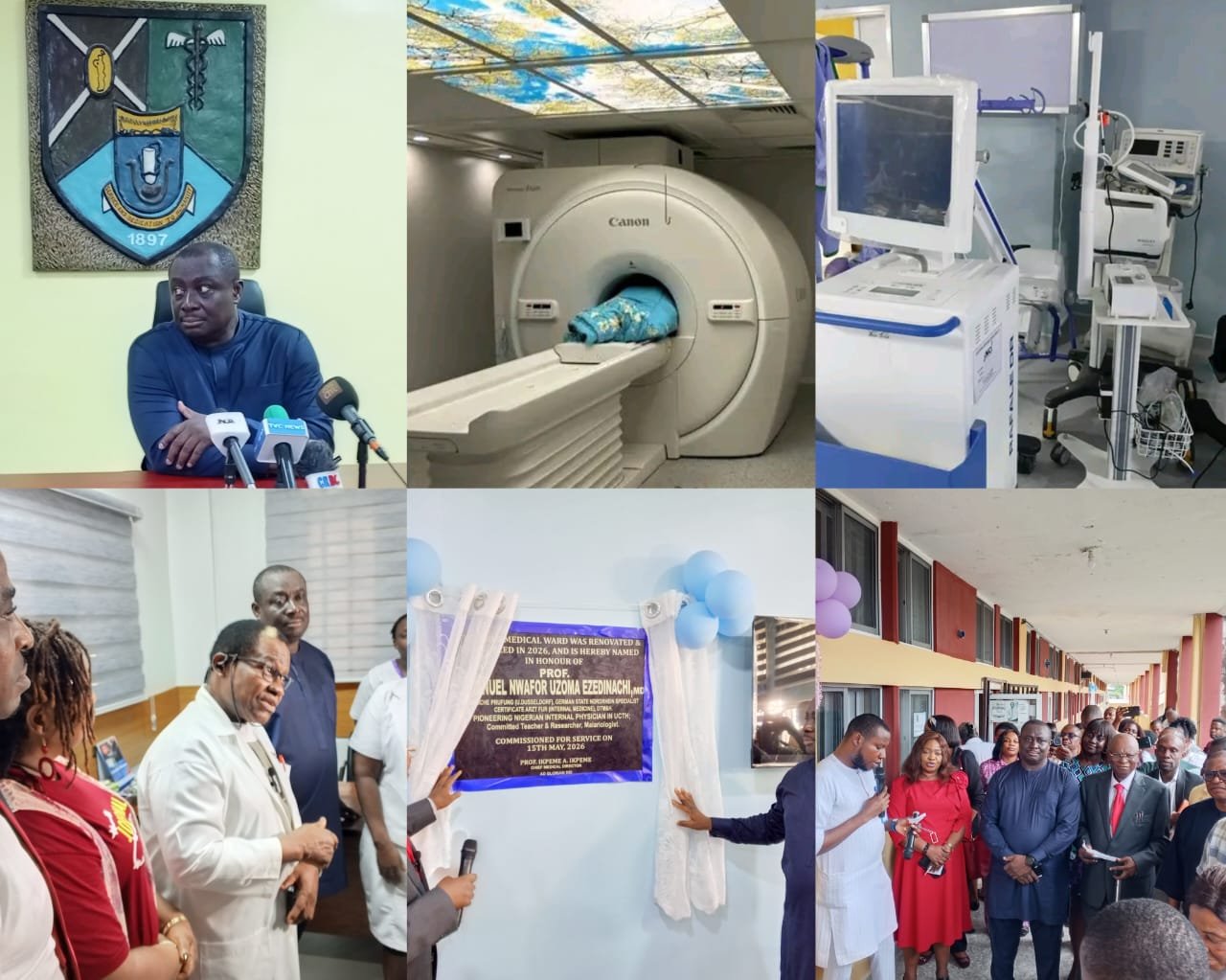
Speaking on the hospital’s “comparative advantages” during a media tour on Friday, Prof. Ikpeme revealed that the facility has moved beyond routine care to specialized interventions including hip and knee replacements, brain tumor surgeries, and advanced “keyhole” (laparoscopic) procedures.
“We’ve got the equipment, we’ve got the personnel, we’ve got the training, and we’ve got the space,” Prof. Ikpeme stated. “If your uterus is giving you a problem, we can take it out using a 1cm incision and cameras. If your appendix is giving you a problem, we can take it out and the following day, we send you home because we’ve done minimal access for you.”
READ ALSO: NNPC Commissions, Handover Installed 1.5 TESLA Magnetic Resonance Imaging System to NAUTH, Nnewi
The hospital, which comprises 62 clinical and non-clinical departments, has undergone extensive renovations. Prof. Ikpeme distinguished between “facelifts” for some wards and “complete remodeling” for others, such as the male medical ward.
A key feature of the remodeled wards is the introduction of 10-bed bays, each equipped with a dedicated nurse’s station to maintain a 1:10 nurse-to-patient ratio. The CMD also emphasized a new policy regarding patient relatives to ensure safety and clinical efficiency.
“The place we were is actually the relative’s area. No relative should go inside the ward except the relative’s attention is required because it obstructs medical and nursing care,” he explained, noting that preventing overcrowding in clinical areas helps reduce instances of assault on medical staff.
Despite being an 850-bed facility, UCTH faces significant pressure as the only tertiary hospital serving a population of approximately five million people across Cross River, neighboring states, and some African countries.
“We get patients from neighboring states, and we even get patients from neighboring countries… Cameroon, Equatorial Guinea, even Central African Republic,” Prof. Ikpeme noted. “There are always space constraints because we are the only hospital that serves that large population.”
To address these constraints, the hospital is currently constructing a new Department of Emergency Medicine. The massive structure is designed to hold 406 beds and will feature dedicated trauma, medical, and surgical bays, a neonatal intensive care unit (NICU), and three large trauma theaters.
While acknowledging the high cost of energy as a major operational challenge, Prof. Ikpeme maintained that the hospital is committed to talking more about its successes. “Somebody said we’re silent, but we’re beginning to talk. And right now, we’re out there.”
Earlier, two newly renovated and remodeled medical wards in the department of Internal Medicine were unveiled by the hospital management alongside families and representatives of individuals whom the wards were named after. The wards are; the female medical ward, renovated and remodeled in 2026, and named after Dr Obal Adiaha Otu, the first Nigerian female Internal Physician in UCTH between 1976-1982.
And the male medical ward named after Prof. Emmanuel Nwafor Uzoma Ezedinachi, a pioneering Nigerian Internal Physician in UCTH.